Wednesday, November 4, 2009

Rake or Hammock. Hmm...


Today was one of those perfect Fall days. Sunny, cool, colorful and that wonderful smell that comes with falling leaves. I did some light pruning, planted some elephant garlic in the Children’s Garden and moved compost. It feels great to be out in the sun.
Long ago, I used to teach a class called “Putting the Border to Bed”. In it I would outline all of the tasks for autumn, including clipping all perennials back and cleaning the ground spotless. I don’t do that anymore. One reason is that a super tidy garden is not conducive to wildlife habitat. The birds and the beneficial insects like a little leaf litter here and there to rummage around in and hide under. Perennial seed heads left up offer an abundance of seeds for little birds. A certain amount of leaf litter adds insulation to the soil and feeds it as it breaks down.
After a good storm I love to walk through the woodland, picking up small branches that have fallen from the trees and breaking them into smaller pieces. Then I toss them back into the woodland to decay and nourish the plants there. Large, matting leaves are removed from the woodland so that they don’t smother the plants beneath them, but smaller leaves, such as Raywood Ash and Japanese Maple are left where they fall. Larger branches are piled on the side as habitat for toads, frogs, newts and such which help keep the garden free of pests.
A wonderful book, which I re-read often, is Mirabel Osler’s “A Gentle Plea for Chaos”. It reminds us that the best gardens are where we gently sculpt Mother Nature, not dominate her completely. Let the roses ramble a bit, don’t be too quick with the rake and look at your garden from the viewpoint of the little creatures that live there.

Monday, October 26, 2009

Berries + Birds = Beauty


Last week I was in my office and looked out at a stand of Mountain Ash trees that is in the corner of the lawn. The trees were moving, but not in the way the wind would cause them to move. On closer examination, I realized that they were filled with cedar waxwings gorging themselves on the berries. A few hours later I noticed that migrating robins had joined the feast. Within a day, all the berries were gone.
I love the huge clusters of red berries on the Mountain Ash (botanical name, Sorbus) but I really love seeing the birds on them. I certainly don’t begrudge them their meal. In fact, front and center in the garden outside my office is a large pine tree that has been loosing it’s battle with pine borers. I know that I will eventually have to take it down. So when two Mountain Ash trees sprouted under it, I left them, hoping they would get a little size on them before I took the pine out. They are now 10-12 feet tall and had their own berries this year to feed the wildlife. They also have lovely white flowers in the spring – an added bonus.
I heartily recommend this tree to anyone who wants a medium sized tree in their garden. I would caution not to locate it over a patio or sidewalk since the berries and the birds can make a bit of a mess. You will also have to weed out a few stray tree seedlings from areas where you don’t want them. Mountain Ash may not be the most exotic or unusual tree on the market, but it is worth having for it’s beauty and it’s place in the bird food chain. There are many different varieties of Sorbus available, but I don’t think the birds find much different about them. So ask your nurseryman about their favorite and see what you think.

Friday, October 23, 2009

A Good Book, A Warm Fire, A Great Garden


Top: Viburnum 'Pink Sensation', Center: Magnolia 'Vulcan', Bottom: Magnolia 'Caerhays Belle'

Today it is raining and cold outside. I don’t mind being wet. And I don’t mind being cold. But I hate being both. So it’s a good day to stay indoors. I have my favorite cat and a new book that I’ve been waiting impatiently for. It is “The Gossler Guide to the Best Hardy Shrubs” by Roger, Eric and Marjory Gossler.
Roger is a good gardening buddy of mine that I have known for quite a number of years. He likes to talk, but unlike most people who talk a lot, he actually has something to say. Whenever I am around him, I feel like the eager student in front of the brilliant professor.
The Gossler family raise the best and the unusual. They are a haven for the plant collector, but should be seriously considered by the average homeowner as well. As the blurb on their dust jacket points out, most housing developments are planted with the same generic landscape plants. These boring shrubs are chosen for the same reason that the cardboard–flavored tomatoes are chosen for the supermarket. They grow fast and they ship well. But these insipid shrubs are just as tateless as the tomatoes. To get a ripe, juicy, knock-your-socks-off shrub, you need to go somewhere like Gosslers. Here are just a few of the trees and shrubs that the Gossler family has turned me on to:
Magnolia ‘Caerhays Bell’ – I had no idea what the bloom would look like. Roger said I needed it, so I bought it. It bloomed it’s second year and the blooms were HUGE, iridescent and bubblegum pink.
Calycanthus ‘Hartlage Wine’ – Guests here at the resort ooh and ahh over it and write the name down on their assorted scraps of paper which they reverently tuck into their pockets like the treasure that it is.
Edgeworthia - I love winter blooming shrubs. This one is stunning for it’s silver felted buds and bright yellow flowers.
Species Rhododendrons – Living in the Pacific Northwest, I was seriously jaded about Rhodies until Roger showed me some that have the most spectacular foliage.
Illicium anisatum – Another WOW plant we have growing in the woodland. Fragrant foliage and confetti flowers.
Chionanthus (Fringe Tree) – White, silky fringy flowers. A stunning small tree.
Fothergilla ‘Mount Airy’ – An absolute knock-out in the fall. The color is so intense it will burn a hole in your retina.
Viburnum ‘Pink Sensation’ – A lovely russet pink snowball viburnum.
Hamamelis- Witch hazels have become one of my favorite plants since being introduced to them many years ago by the Gosslers. They flower in winter, are a graceful shrub during the summer and then have vibrant color for the fall. What more can you ask.
Magnolia ‘Vulcan’ – A deep ruby red. This tree grew and flowered quickly and gets rave reviews from guests each spring.
There are many more shrubs and trees that have made their way from the Gossler Nursery to our gardens. If you want to spice up your garden with a plant that will awe your neighbors, check out their book, available through Timber Press and then get on line (http://www.gosslerfarms.com/) or call for a catalog at 541-746-3922. For a real treat, call for an appointment and visit the nursey where you will also find an awesome display garden.

Saturday, October 17, 2009

Cats in the Garden


We talked a while back about gardening with Dogs, but what about all of my kindred spirits out there who are cat people? And what about you poor folks who’s neighbors are cat people?
It seems the worst thing about gardening with cats is finding little “presents” in the flower bed while you are digging. Kitties seem to like the same loose soil that plants do. There are a number of ways to deal with this, some more appealing than others.
I have a brick planter in front of my house, covered by an overhanging roof. In the winter, the soil in this planter is much dryer than soil in the outlying areas, so the cats would use the planter as their bathroom, leaving a rather offensive smell. I cured this by throwing several tangerines in a blender with some water and pouring it along the back of the planter. The cats don’t like the smell of citrus, especially tangerine and left it alone for a good month or more. Another idea that works is to keep the soil moist. Cats search hi and low for a dry spot to poop in. I eventually solved the problem for good by planting a low, evergreen hedge (sarcococca) in the planter and keeping it trimmed tightly so there is no room for cats to get in underneath and dig. Now I’m rewarded with the sweet-smelling winter flowers of the sarcococca instead of the not-so-sweet smell of cat scat.
Similar problems can arise in the winter with cats digging beneath your deck where the soil is dry. Skirting around the deck is just about the only way to cure this.
I think the worst problem with cats is finding cat poo in your vegetable garden. You don’t poop in their food dish, why would they think this is OK? There are several ways to handle this. One friend remarked that since they had built a deer fence around their garden, they didn’t have deer, but they also didn’t have the annoyance of cats. If you don’t live in deer country though, fencing your garden to this degree can be a little drastic. You could try fencing around the garden with 5’ wire fencing with 2” openings, but you will have to use metal posts since a cat can (and will) climb a wooden post. Since the cats are looking for loose dirt, one friend of mine sticks plastic forks – tines up- in any patch that he has just cultivated. He keeps a bucket of them by the garden path. Another friend keeps the cats out of the garden by giving them their own sandbox at the back of the property. Believe it or not, I think this has been the best solution out of all of them. The cats would much rather poop in sand than have to dig in irrigated soil, so they use that and leave the rest of the garden alone.
My last solution is any one of the sprays available to keep animals away from your garden, but you won’t want to spray this on your vegetables and you need to repeat spray often.
Since we have talked at length about cats and their bad habits, in all fairness, I think I should also include some fun elements to put in the garden for those of us who do love our cats. The first is height. A cat loves to climb and have high spots to survey their domain. The carpeted cat towers are great for a covered back porch or deck. A wooden ladder leaning against a tree can be great fun. They also love warmth. Our cat, Dashiel had a favorite flat rock by the studio that he loved to sleep on in the sun. When he died we buried him under it so now it’s his headstone. Patio chairs are often claimed by the cats to sun themselves on. If this bothers you, give them their own sunny blanket or towel somewhere else.
Last but not least – Spay or neuter your cat so that we don’t increase the population. Free kittens are always available at your local shelter, you don’t need to grow your own.
If you have other tips and tricks about living with cats, I’d love to post them on the blog. Simply reply in the comment box.

Friday, October 9, 2009

Autumn Seed Toss


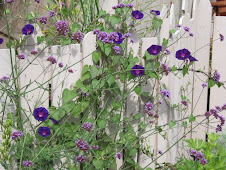
Above: Shoo Fly Plant - Nicandra
Below: Kiss-Me-Over-The-Garden-Gate
Polyganum orienatale (Persicaria orientale).
As I walk around the gardens this late summer day, I am noticing all of the holes where nothing was planted this year. I’m not particularly apologetic about it. The recent event where the economy met the crapper has cut our staff down to a skeleton crew, and still they managed to keep the gardens looking lovely. But in an attempt to trouble shoot for next year, I am realizing that many of these holes can be filled up next year with annuals that we grow in-situ with seeds.
You may ask what gave me this brilliant brainstorm. It is, simply, the Kiss-Me-Over-The-Garden-Gate that grows around the entrace to our gardens. This annual, botanically known as Polyganum orientale (aka Persicaria orientale) self-seeds itself every year and comes up each spring all on it’s own. Each year at our festival in September, we have multitudes of visitors asking what it is and where they can get it. One frustrated lady tracked down my e-mail address and lamented that she hadn’t been able to find it in any nursery. Well, no, you probably won’t. The only time I have seen it offered in the nursery was when they came out with a new variety a few years ago. It had variegated leaves and paler flowers, but didn’t have the same “Oomph” as the original. I haven’t seen it since.
So how do you get it? Find someone who has some, steal or beg some seeds and toss them into your garden immediately (as in now, autumn). Don’t till the soil first, don’t bother covering them up. Just toss them. Next spring they will come up with two oval, pointed leaves and bright red stems. Thin them out a bit and then keep them watered. By fall you will have 6’ plants dripping with dark pink-red flowers.
There are other annuals that will come back year after year by reseeding. Nigella (Love in a mist), Nicandra (Shoo Fly Plant), and Datura meteloides (poisonous) all reseed each fall and come back each spring with no effort on our part. One caveat is that if you want to get rid of these plants, you may have to weed them out several years before they are completely gone. But I would never want to get rid of them myself.
Other annuals that grow well with little preperation are Marigolds, Zinnias, Morning Glories (Ipomea varieties are not invasive like bindweed), Amaranth, and Cosmos. These just need to have the soil worked up a bit, a little fertilizer added and then plant and water.
Seeds are so much cheaper than plants and you don’t need a greenhouse to start many of the annuals available. The hardest part is waiting for the soil to warm up enough before you plant them. Put them in too early and they’ll rot. I wait until May for most of the annuals. If you have to get a quicker show, start them on a windowsill in April.

Sunday, October 4, 2009

Steal a Little Creative Inspiration


I am a collector and a thief…..I steal clever ideas from other gardens and collect them in photographs, lists, and tattered folders. I rarely, if ever use these ideas exactly as I stole them, but I collect them and then go through them, touch them, experience them and then create my own version of these bold strokes of creativity. They are my muses, my mentors and my teachers.
For instance, after years of photographing other gardens, I have finally realized that what attracts me first are the elements that would attract a child. Anything whimsical, creative, cute or clever. I may take a picture of the black taro to have in my files, but it’s the beautiful ironwork grate that covers the mundane drain that really catches my eye and begs to be photographed.
On a recent trip to Chanticleer, in Pennsylvania, I took picture after picture of their Apple House. Originally a small cellar-like structure for storing apples, they had painted murals of chipmunk holes on the inside and made it a completely charming little piece of the garden.
Another idea that I stole with my camera is their habit of putting brightly colored chairs, usually in pairs, all over the garden. A little bit garden art, a little bit invitation to sit and rest, enjoy the view, stay awhile.
My daughter, Bryn was with me for this trip and I could see the same excitement sparked in her inner child as I felt in my own. She loved the restrooms that were created to look like a Japanese dwelling, the creative ironwork or woodwork that graced every bridge, and the clever little boxes that held the plant lists for each garden.
The feature that blew us both away was The Ruin. Not sure if it was an actual ruin of a stone house or whether it was created, but it was sublime in it’s detail. Stone books graced the library, a giant stone “pool table” mesmerized us both (and the pun was not lost on either of us).
I had planned to “skim” through this garden on our way to another, but even though we were exhausted from catching the red-eye flight from Eugene just 14 hours earlier, no sleep, a nightmare experience with the rental car agency and hot, humid weather, we ended up spending many hours basking in the creativity of this garden.
Notice how I have written about this garden without mentioning any of the plants? The plants were equally clever and beautiful and bountiful – not a hole in any single garden, but what made it beyond special was all of the little artistic touches outside of the plants.
So here’s a challenge for you. Go through the pictures you took at your last garden tour, or garden show. Check out how many were of plants and how many were of clever little accents. I think it’s a very powerful lesson on designing any garden.

Wednesday, September 9, 2009

A Gift for Autumn


Last Friday, as I walked through the Woodland, I noticed four of the cyclamen in the Woodland were blooming. When I returned after a 3 day week-end, there were forty. In another few weeks, there will be closer to 400 or more. These little harbingers of autumn are so delicate, you would expect them to bloom in the summer, but in a turn of the clock, they start blooming in fall and often bloom well into the winter. The variety I’m talking about is cyclamen hederifolium or, literally ivy leaved cyclamen. The foliage emerges not long after the flowers and is patterned in silver. The foliage will last long after the flowers fade, finally disappearing in the late spring as it goes dormant for the summer.
These little beauties grow off of a corm that can start out the size of a cherry pit and eventually become as large as a saucer. They don’t tolerate much water in the summer, while they are dormant, so put them in a spot away from the irrigation.
I buy them in the winter and plant them in our planters by the front door, then when they fade, I take them down to the woodland and tuck them in with the rest of the patch.
By spring, you will notice seed pods the size of a small marble attached to tendrils wrapped up like a spring. The seeds are often carried off by insects, such as ants that eat the waxy coating and then drop the rest of the seed along the trail back to the ant nest, so it is not uncommon to find a line of cyclamen seedlings leading away from the original patch. Since the little darlings seed so freely, you will soon have a respectful patch without any large investment.